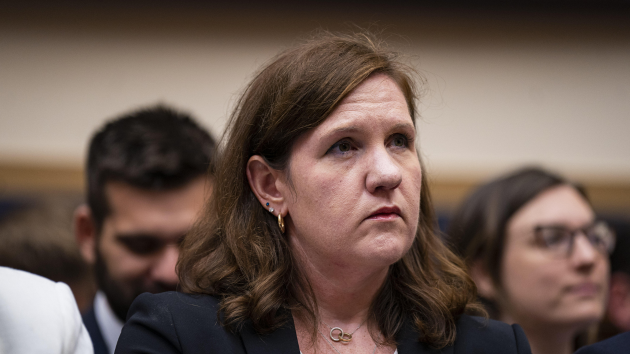
(WASHINTON) — The Supreme Court on Monday appeared likely to allow President Donald Trump to remove a Democratic member of the Federal Trade Commission purely for policy reasons, likely rolling back 90 years of legal precedent that had prevented at-will removal of independent agency officials in a decision that would expand presidential power.
The case could transform the federal government and effectively end the independence of some two dozen bipartisan agencies that Congress had designed to be insulated from political interference and direct White House supervision.
All six of the Supreme Court’s conservative justices indicated during oral arguments in the case, Trump v. Slaughter, that a president should have absolute control over the leadership of any government body carrying out executive functions, such as rulemaking and law enforcement.
They pointed to Article II of the Constitution which says, “the executive power shall be vested in a President” and that he alone “shall take Care that the Laws be faithfully executed.”
Such a ruling would overrule or substantially limit a unanimous 1935 Supreme Court decision involving the FTC — Humphrey’s Executor v. U.S. — which had affirmed limits on a president’s ability to fire members of the commission only for cause.
“Humphrey’s Executor is just a dried husk of whatever people used to think it was,” Chief Justice John Roberts said bluntly.
Justice Samuel Alito suggested that the earlier Supreme Court had egregiously erred, opening the door for Congress to circumvent the president altogether if it wanted to.
Could every Cabinet office “be headed by a multi-member commission whose members are not subject to at-will removal by the president?” he asked Amit Agarwal, the attorney representing the terminated FTC Commissioner Rebecca Slaughter.
The Supreme Court’s three liberal members vigorously defended the agencies as they were designed by Congress — and signed into law by prior presidents — as legitimate sentinels of the public interest and regulatory continuity across administrations.
“You’re asking us to destroy the structure of government,” Justice Sonia Sotomayor told Trump administration Solicitor General John Sauer.
Justice Elena Kagan said she worried about a slippery slope.
“The result of what you want is that the president is going to have massive unchecked, uncontrolled power not only to do traditional execution [of the laws] but to make law,” Kagan said, referring to the agencies’ regulatory authority.
Justice Ketanji Brown Jackson warned of the “danger” in allowing a president to replace members of independent commissions with “loyalists and people who don’t know anything” about the agency’s expertise.
Independent agencies have regulated American monetary policy and stock trades, transportation systems and election campaigns, consumer product safety and broadcast licenses historically overseen by subject-matter experts from both parties.
“If the petitioners get their way,” said Agarwal, “everyone is on the chopping block.”
Few of the conservatives seemed concerned about the consequences.
“It’s been suggested if we rule for you, the entire government will fall,” Alito told Sauer.
“The sky will not fall. In fact, the entire government will live with accountability,” Sauer replied.
Justice Brett Kavanaugh, one of the justices most often in the majority camp on the Supreme Court’s decisions, made a point of downplaying the impact of potential fallout.
“Overruling or narrowing Humphrey’s won’t affect the existence of these agencies,” he pointed out. Sauer agreed.
Kavanaugh also suggested the Supreme Court is likely to carve out two exceptions to a ruling that would give a president greater control: the Federal Reserve Bank, which is also an independent agency, and administrative courts, such as the tax court, which are operated out of the executive branch.
Next month, the Supreme Court will hear arguments in a case involving Trump’s unprecedented attempt to fire a Democratically-appointed member of the Federal Reserve, Lisa Cook. She currently remains on the job after the justices declined Trump’s request to stay a lower court decision.
The outcome in the Slaughter case will determine whether or not there will be any Democrats left on the FTC or other regulatory bodies, and whether any of the other independent agencies will be truly “independent” any longer.
A decision in the case is expected by the end of June 2026.
Copyright © 2025, ABC Audio. All rights reserved.